Показ дописів із міткою Астрономія. Показати всі дописи
Показ дописів із міткою Астрономія. Показати всі дописи
21 листопада 2022 р.

12 квітня 2021 р.
ВІРТУАЛЬНИЙ 3-D ТУР НАЦІОНАЛЬНИМ МУЗЕЄМ КОСМОНАВТИКИ ІМ. С.П. КОРОЛЬОВА

ВІРТУАЛЬНИЙ 3-D ТУР НАЦІОНАЛЬНИМ МУЗЕЄМ КОСМОНАВТИКИ ІМ. С.П. КОРОЛЬОВА
3-Б
Віртуальний тур Національним музеєм космонавтики ім. С.П.Корольова у Житомирі.
Запрошуємо вас здійснити віртуальну прогулянку єдиним в Україні музеєм космонавтики.
Уявіть себе відважним підкорювачем космічних глибин та пройдіться під величезним космічним кораблем, детально роздивіться осколки метеорита, місячний ґрунт та дізнайтесь, яку їжу в тюбиках брали в політ космонавти.
Експозиція була створена Народним художником України Гайдамакою Анатолієм Васильовичем.

2-A

1-Б

We travel
without leaving our classroom
Cultural life in conditions in a state of emergency
situation must be continued. Therefore, an online excursion for students was
realized and conducted.
A lesson in a museum is a great opportunity to put
school knowledge into practice in an unusual space flight situation. And
although the flight is not real yet, the students have to solve real problems.
It was the virtual tour of the National Museum of
Cosmonautics named after S.P.Korolyova in Zhytomyr. This is the only one museum
of cosmonautics in Ukraine.
The students imagined
themselves as brave conquerors of space depths and walked under a huge
spaceship, they looked in detail at the fragments of the meteorite, the lunar
soil and got to know about food in tubes the astronauts took in their flight.
The exposition was created by the Public artist of Ukraine Anatolii Vasylovych
Haidamaka.
The tour ended with a final conversation, during which we summarized,
systematized what we saw and heard, we highlighted the most important and
expressed our impressions and assessments.
Visiting the museum motivated students to create beautiful drawings of
future spacecrafts.
Feedback from students about visiting the museum.
I remember the Soyuz-27 spacecraft's lander; 9 milligrams of lunar soil;
exhibition sample of the Soyuz spacecraft, models of the Lunokhod-2 and the
life-size launch vehicle of the Gagarin Vostok; astronauts flying things, space
food. If the opportunity arises, my family and I will definitely visit this
museum (Makhnitska Vladislava, 6th grade student)
Here you can see numerous examples of space technology, look at
simulators, which were worked on by experienced specialists, get acquainted
with the landing spacecraft, in which the astronauts returned to earth, a
rocket engine. It is possible to contemplate the model of the Moonwalker-2,
spacesuits. An important role in the feeling of space is played by the central
part of the exhibition "Space" - a small pool filled with water in
the center of the hall, which houses the Bible. I also liked the short videos,
which tell about welding in space, sound recording. (Mikhail Grinik, 8th grade
student)
9 квітня 2021 р.
Як ми підкорювали космос?
Інформатика+Фізика+Математика+Астрономія

Наші космічні пригоди
продовжуються! Сьогодні ми працювали із надзвичайно цікавим додатком https://www.geogebra.org/
Чудова колекція аплетів про
космічні подорожі та ракетобудування - https://www.geogebra.org/m/aDzIMpKP
Space Is Our Future
"Man must rise above Earth to the top of the atmosphere and beyond,
for only then will he fully understand the world in which he lives" –
Socrates.
Online activities introduce students to the history of domestic and
world astronautics. With the help of STEM, children build, explore, and program
space objects and plan flights to the stars.
In early March, I registered for a great course from the European school
academy Aerospace in Class. During the course, I learned a lot of new, useful,
and important information. Applying the course material, I developed a lesson
plan and implemented it with the students at my school. The lessons involved
students from Grade 5 to Grade 10.
Since we are currently studying online, my activities were organized via
zoom, taking into account the time limits for students of different ages. The
cycle of activities lasted from April 8 to April 18, so as to include April 12
– the International Day of Human Space Flight.
During the first stage of the lesson, the students were familiarized
with the history of flights, literary works by famous writers and the
development of astronautics; later, they went on a virtual tour of the National
Museum of Cosmonautics.
Then the students worked with the resources from https://www.airbus.com/. The use of the
Airbus Foundation Discovery Space piqued the students' interest and stimulated
creativity and motivation. The children watched videos, discussed them, and put
forward various hypotheses about space travel.
The next step was to study the jet motion and determine the speed of a
spacecraft relative to the Earth. After working on the physics material, the
students compiled a Python program to visualize the results. At the same stage,
younger students were working with https://www.airbus.com/company/sustainability/airbus-foundation/discovery-space/kids/mission-to-the-moon.html, where they
learned about space and how to survive it by playing exciting games. Following
that, they made a Scratch project for a flight to the Moon.
My students also enjoyed the construction of a paper rocket and its launch.
Another group of students also showed their creativity by creating models of rockets
in Tinkercad.
Finally, the use of resources from https://www.geogebra.org/ allowed us to
study, explore, and understand complex space processes with the help of
mathematics. Dynamic models made it possible for the students and the teacher
to illustrate, visualize and demonstrate various astronomical concepts.
I believe that thanks to these activities, space will become a lot
closer to my students in the future.
28 серпня 2018 р.
Наука та технологія
У п'ятницю, 27 липня, українці поряд з жителями з різних куточків світу змогли спостерігати унікальне явище - найтриваліше місячне затемнення сторіччя. Воно тривало без малого 4 години, за цей час Місяць пройшла через тінь Землі і отримав багряний відтінок, через це вчені прозвали затемнення "кривавим".
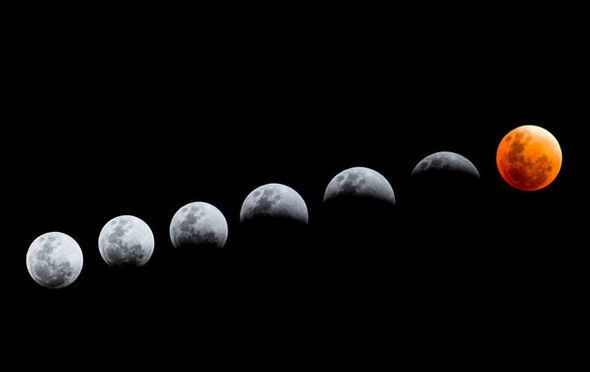
Затемнення Місяця можна було спостерігати з22:30 27 липня до 00:14 28 липня по київським
часом.


Підписатися на:
Дописи (Atom)

